The Drone That Responds to 911 Calls Faster Than Any Human Can
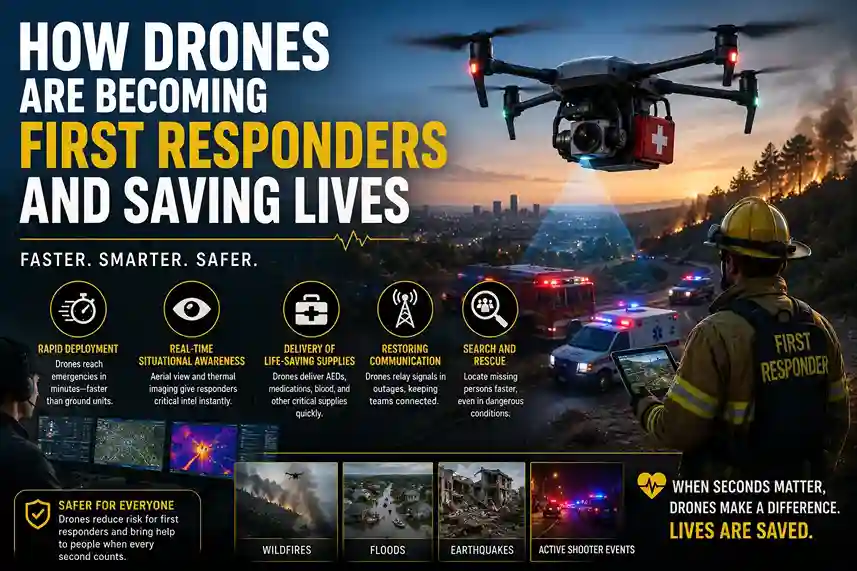
For many people, drones are a scary concept. They evoke images of weapons on battlefields and in the skies over conflict zones, creating damage and devastation at a massive scale. Recent reports show that a large percentage of casualties inflicted on forces in some conflicts were done via drone strikes. This is a terrifying new reality that cannot be ignored. But there is an entirely different kind of drone use, much closer to home, that is already having life-saving impact.
How Remote Drone Technology Works
A demonstration showed a drone being controlled from one location while it was actually flying in another country. The operator clicked a launch button on a laptop and a real drone launched itself on the other side of the world. It was a bit like playing a video game, but with a real drone flying in real space. The thing that made this possible is called a dock. It looks like an intergalactic grill but contains advanced technology that turns the drone into a fully autonomous device. It can be flown remotely without a person on scene, and it turns the drone into a software-defined thing. The software keeps the drone safe, allowing it to cruise, tap on objects of interest, and autonomously track vehicles. It can also initiate autonomous patrols of an area.
Drones Responding to Emergencies
A police department in Oklahoma has placed dock drones all over their city and is using them to respond to emergencies. In one instance, a train operator called 911 in a panic, afraid that he might have hit something or someone on the tracks. The area was very difficult to access. On the ground, it would have been about an hour of searching, but the drone got there in seconds. It found that there was somebody on the tracks. Because of the drone, first responders knew exactly where he was and were able to guide them in, saving the man’s life.
In San Francisco, a different application used the same concept. Responding to a 911 incident involving a stolen vehicle, the drone followed the stolen vehicle from the air. Officers knew exactly where the suspect was and what he was doing. The suspect had stolen license plates and was tinting the windows, clearly beginning a crime spree. But the cops knew exactly where he was and what he was doing. They rolled out a plainclothes unit and spike strips. The suspect got flat tires and could not go far. They took him into custody. This was safer for everybody involved: safer for the community, safer for the officers, and even safer for the suspect because officers knew exactly where he was and what he was doing.
Measurable Results in Crime Reduction
Since the San Francisco Police Department implemented this technology, they have seen a 30 percent drop in crime and a 40 percent drop in auto theft. The concept of drone as first responder is taking off across the country. It started with a few agencies, but hundreds are now using it. By the end of the year, it will be thousands. Right now, about five percent of the US population lives within a two-minute flight of a drone that can respond to an emergency. There are 240 million 911 calls every year in the US. The goal is a future where the default expectation for every emergency is that a drone shows up in a few seconds to provide targeted information and get better outcomes for everybody.
Drones for Infrastructure Inspection
Energy utility customers are installing these drones in their substations. An energy company in Ohio has a pioneering program with a dock in the substation. They use it to perform both proactive and reactive inspections. On one of those flights, they spotted a distribution pole with signs of a short and a fire that they would not have caught any other way. Thanks to the drone footage, they knew exactly where it was and repaired it.
This matters because some of the most devastating fires have been the result of energy utility faults. When something breaks, there is a short, and it starts a fire. Drones enable a complete digital picture of the grid to prevent this kind of thing from happening. If it does happen, they can know about it sooner and faster and mitigate the response.
The Technical Complexity Behind Drones
Flying cameras all over the place to get better information is super impactful, but the same concept applies to drone delivery. Companies are using dock drones to make it safer and faster to get items delivered to doorsteps. There is a mountain of technology under the hood that makes this stuff work. Drones are deceptively small, but they are actually on par with self-driving cars and rocket ships in terms of technical complexity. There is vibration, thermals, and aerodynamics to deal with. The hardest part is making all this work reliably when and where it is needed.
The key enabling technology is eyesight, giving drones the same ability that humans have to look out and see the world. Drones have very powerful computers built in that parallel human brains. They have deep neural networks that parallel biological neural networks. The output is very similar to how humans see the world. They know where things are, what they are, and can use all of that information to make intelligent decisions.
Autonomous Inspection in Action
In another demonstration, a drone performed an autonomous inspection of a water tower. The operator interrupted the inspection, clicked stop, and returned and landed the drone. The dock opened up, and the drone used vision and AI to detect its landing spot. It came in and did an automated landing. The dock, in some ways, turns the drone into something like a cloud server, where these things can be running autonomously, continuously in the background, doing useful work on our behalf.
On an autonomous patrol like this, drones can inspect infrastructure and look for intruders. They can provide a complete digital picture of everything that is happening. In the 20th century, transportation infrastructure, power infrastructure, and communication infrastructure were built. Drones have the potential to fundamentally advance and transform how all of this infrastructure is operated. But infrastructure is also a good way to describe what the drones themselves are becoming. These things are dynamic, intelligent, and can run in the background doing useful work constantly, 24/7.
Conclusion
Drones can be scary when seen on battlefields. They can also be seen as toys and tools of entertainment. But there is a very useful function for this technology: to go where people cannot go, or to go faster to a place before people get there. This is the idea of drone as first responder and drone as infrastructure monitoring. Recent fires in some areas could have been prevented if drones had been surveying power lines and infrastructure.
Like most things, this technology is dual-use. That is why these conversations are important. People ought to know about what the technology is capable of and how it is being used in every facet of society. That way, there can be a discussion about what to do with it. Drones are here to stay, and they are already saving lives and preventing disasters. The future of public safety and infrastructure management will increasingly rely on these autonomous flying machines.