The Price of Dissent in America Is Too High and We Are All Responsible
Not long ago, a man was walking his dog named Martini. His wife was out of town, so he left his phone inside to get away from the buzzing. When he came back, he had hundreds of missed calls from numbers he did not recognize. He opened his voicemails and heard people threatening him. They called him disgusting, a traitor, a piece of shit. They said they would dox him, that he would not be able to walk down the street. They said he would deserve the wrath of hell. And those were the nice ones.
How He Ended Up in Washington
Like many people, after the attacks of September 11, 2001, he wanted to come to Washington to make sure a day like that never happened again. He started as a young messenger on Capitol Hill, the lowest place possible on the totem pole. He was delivering envelopes during his junior year of high school. Despite being the lowest rung, he had the best desk in Washington, better than the Resolute desk inside the White House. His desk was in the back of the chamber, where he had a perch to see the comings and goings of Congress.
In that time period, he saw unity. He saw members of Congress walk across the aisle to work together on legislation to protect the country. But times change. Everything fades.
Working Inside the Trump Administration
Fast forward to 2017. He found himself as the chief of staff of the US Department of Homeland Security. It was not a time of unity anymore. He took that job because his boss gave him the worst sales pitch in history. His boss said, “It’s not as bad as it looks inside the Trump administration. It is so much worse.” He took the job anyway because he understood they needed people who understood how government functions to help steady the ship.
But he soon saw what others saw. In meetings with the President, he found a man who was reckless and impulsive. On days when members of Congress and cabinet secretaries walked out of the Oval Office with ashen faces, they said things like, “The man is a threat to the fabric of our republic.” He had to spend most of his time not focused on the 250,000 men and women of the Department of Homeland Security, but on one man who was regularly engaging in or attempting to engage in illegal acts.
There was no deep state inside the Trump administration. There were people willing to speak truth to power and prevent the President from doing illegal things. But he grew frustrated because these conversations were happening among a group of unelected bureaucrats, navel gazing and wringing their hands. It was not their job to decide if the President was unfit for office. That was for the people to decide.
Going Public with the Truth
He decided to go say what they were talking about in private in public. He did that first anonymously, not because he was afraid to stand by his opinions, but because he is a student of history. His favorite book is “The Federalist Papers.” The Founding Fathers wrote anonymous essays to sell the American public on the Constitution, not because they were scared, but because they knew it would create a spectacle and draw attention. He used the same device. It worked. They started a national conversation about how the President’s own lieutenants did not think he was fit for office.
The President noticed. In a seven-letter, all-caps tweet, he said “TREASON?” The man was grateful there was a question mark because treason is punishable by death. The President subsequently said he wanted the author found and turned in for national security reasons. But lawyers in the White House said the article was First Amendment-protected speech and they could not pursue the person.
Taking Off the Mask
In 2020, he felt like he needed to take off the mask because behind the mask, he was sending the signal that it was okay to sit in the dark and put opinions out there without taking accountability. Before that election, he needed to go out and tell people the specific things he saw and let them make up their own minds about whether this guy deserved to be reelected.
Once again, the President noticed. He said at campaign rallies, bad things were going to happen. He was right. They did. His supporters made sure of it. As a consequence of his rhetoric and accusing him of treason, the man had to leave his home on Capitol Hill. He lost his job in the private sector. He lost his life savings spending it on lawyers, security, and friends. On election night 2020, he found himself in a safe house in Northern Virginia under armed guard with a pistol under his pillow. So many of his fellow Americans believed he should die for criticizing the President.
The President’s Executive Order
Fast forward to April 9 of this year. Donald Trump had lost in 2020 but won and came back to power. On that day, the man was out with his dog again. He got a message from a journalist saying, “Turn on the news. The President is talking about you in the Oval Office.” He pulled it up on his phone, and there was Donald Trump declaring not that he might be guilty of treason. The question mark was gone. He told the American people and the world that he believed the man was guilty of the highest crime contemplated in the US Constitution, a crime punishable by death.
Legal scholars later told him it was the first time in 249 years of the American Republic that a president has issued an executive order to investigate one of his critics for First Amendment-protected speech. If treason is tantamount to murder, why is he standing there today? Why is he not in handcuffs? The answer is because the US justice system has not caught up to the President’s view that criticism of a president is subversive, that criticism should be criminalized, that you need a permission slip to criticize the president. The justice system has not caught up to that yet.
The Consequences of Speaking Out
But the people who followed his dog whistles were paying attention. They called and left more threatening messages. The address of his home was doxed. His phone numbers were doxed. His wife asked if they needed to sell the house to pay for legal fees. The business he had built was destroyed, and 50 people no longer received paychecks. The hardest part was watching not just him get death threats, but his wife threatened and his one-year-old daughter threatened with her image posted on the internet. His security advisor did not want him to come speak today because of the environment.
The Unremarkable Nature of This Experience
What is remarkable about his experience is that it is unremarkable now. What has happened to him is happening to people at every level, from members of Congress down to state representatives and Parks and Recreation directors. Poll workers are threatened with crowdsourced violence. Members of Congress are scared to hold town halls because of their constituents on the Left and the Right.
Here is a data point: the year Donald Trump was elected president, there were 1,000 death threats a year to members of Congress. By the time he left office, that had gone up tenfold to 10,000 death threats a year. This number has hovered around that level. It is indicative of what is happening in other parts of society.
The Desk That Became a Symbol
On January 6, 2021, a desk was slid from the corner of the house chamber. It was the desk he had sat at as a congressional page in a Washington unified against a foreign enemy. It was slid in front of the door and became the last line of defense against a violent mob of insurrectionists. He gets chills talking about it because of how quickly the world changed.
Who Is Responsible for the High Price of Dissent
Recently, we saw the assassination of a top political commentator on the right. Just last week, the top Democrat in Congress had an assassination plot foiled against him. It begs the question: who is responsible for the price of dissent being so high in America? If you think the answer is Donald Trump, you would be wrong. The answer is you. Or some of you.
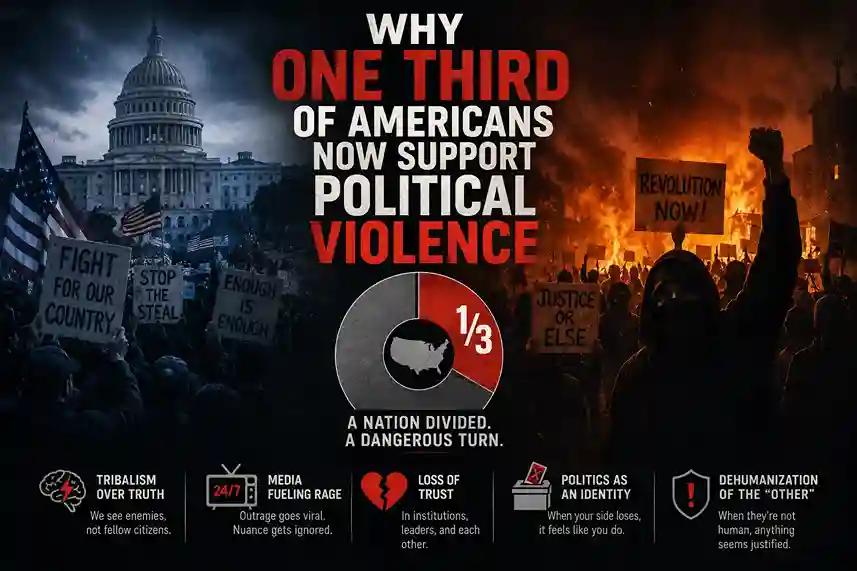
A survey showed that one in three Americans now believe that political violence would be justified to put the country back on track. One in three Americans own a cat. Think about that. Which political affiliation do you think is more likely to hold this view? Democrats and Republicans in equal measure statistically.
The Problem of Anonymity
You might be sitting there saying you are not one of those one third. You did not call his phone that day. Statistically, you are probably right. You probably fit into this category. A recent survey found that two out of three Americans are now actively admitting to self-censoring their views out of fear of reprisal. It is not just people inside the beltway. It is everyone. The vast majority of Americans agree in private on almost all the controversial issues in our society: immigration, abortion, climate change. Majorities agree on those issues, but they are scared to say it, including being afraid to repudiate political violence.
So who is responsible for the price of dissent being so high? It is not Donald Trump. It is not even the one third of Americans who believe we might have to use political violence. It is the two thirds. The greatest threat to democracy today is anonymity. People are wearing their figurative masks. They are scared to tell the truth. When people are scared to tell the truth, intimidation works. It works very well.
How to Lower the Price of Dissent
How do we fix this? In economics, when supply and demand meet, that determines the price. If the price of dissent in this country is high today, how do you lower it? Economics teaches there are only two ways. One, you could decrease demand. But if you believe in what the Founders said about America, you do not want to decrease the demand for truth, debate, and the possibility of reaching accord on important issues. So the only way to lower the price is to increase the supply. That is you. You are the good in that marketplace. We need more dissent. We need people unafraid to step forward and speak the truth.
Conclusion
There are a lot of scary things happening in this country right now. It is understandable to ask, “What is going on here?” But before you answer that question, ask yourself and the people around you another question. Am I anonymous still? If the answer is yes, then you also know the solution. It is within your control. That solution is that it is time to take off the mask. The price of dissent will only come down when more people are willing to speak their truth openly and without fear. The future of democracy depends on it.