One Dinner Conversation Changed Everything and It Could Change Your Life Too
In 1983, a 25-year-old man named Danny was at a crossroads. He had graduated from college with a political science degree and was working in sales. He sold security tags attached to clothes in department stores. He was good at it and making good money. But he had always planned to go to law school. The night before the LSAT, he was having dinner with his uncle Richard. His uncle could tell something was wrong. Danny admitted he did not really want to take the test. His uncle asked why he was doing it. Then he said something that would change everything.
What Drives Career Excellence
For six years, a researcher studied what drives career excellence. They combed through over 100 biographies, talked to leading academicians, looked at their research, and did their own survey. They found many common traits, but one thing stood out above everything else: continuous and obsessive learning. The people who excelled in their fields were all lifetime students. They knew the history of their field. They understood the nuance that separates great from good. They knew the edge of their field where innovation lies. They studied throughout their entire career, beginning, middle, and end.
These people thought about their craft as an artisan with an artisan mindset. These artisans exist in every field. At a chess competition, they held a history trivia contest. The world champion won because he was not just great at chess. He knew the history.
Fascination Is the Key
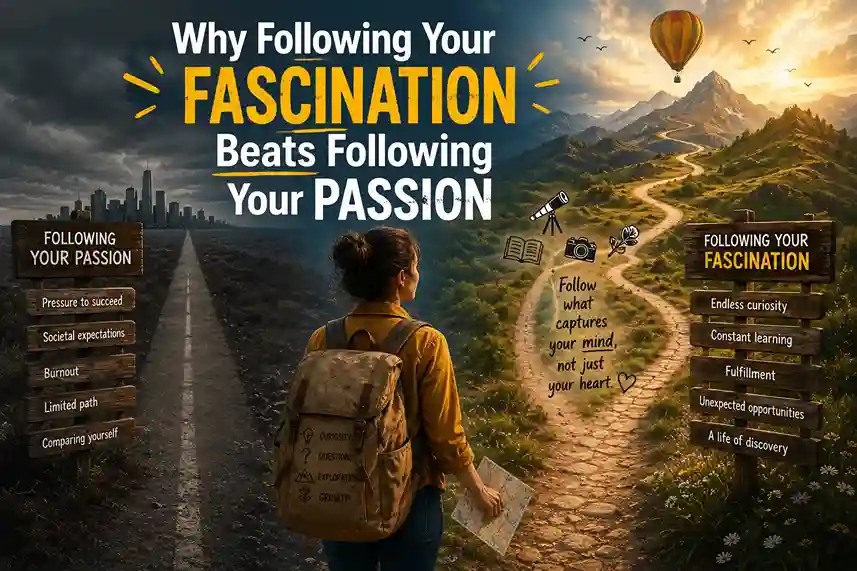
Here is the key point. Obsessive and continuous learning is not an input. It is an output. It is not the cause, it is the effect. What drives someone to learn for a lifetime? A famous comedian gave a commencement speech and made fun of the phrase “follow your passion.” He came up with a better word. He said you should follow your fascination.
This is an important distinction. Passion does not invoke work. You could be passionate about a sports team and sit in a chair for hours drinking beer. But fascination comes with the mechanism. When you are fascinated, you study automatically. You do it without conscious effort.
Danny’s Journey to Success
Back to Danny. His uncle kept pressing him. He pointed out that all Danny had ever thought about and talked about his whole life was food and restaurants. Why not open a restaurant? Danny listened. He took the LSAT the next morning but never enrolled in law school. Instead, he enrolled in a restaurant management course he found in a magazine. He took a 90 percent pay cut to get his foot in the door at a local restaurant, where he could rotate through different jobs. He planned a trip through Europe where he would work for free in many different countries and cuisines.
He went back to New York and studied more. Then in 1985, a full year after that momentous dinner, Danny opened his first restaurant. It would be recognized as a favorite restaurant many times. He went on to launch over a dozen high-end restaurants. He also founded a fast-food chain that has hundreds of locations worldwide and a multi-billion dollar market cap.
Every time Danny started a new concept, he would do a year of learning and study before launching. When he was interviewed, he had just returned from Europe on another learning tour. Over 40 years later, learning was still in his DNA.
What Happens When You Combine Fascination with Career
Magical things happen when you combine fascination with a career. First, you are more fulfilled and happy. Second, the learning comes for free. Zero conscious effort. When you learn about something you do not like, it saps your energy. You get tired and need a break. When you learn about something you are fascinated by, you get energy and want to smile.
Third, people notice. If you are enthusiastic and have extra knowledge, you will do better in every dimension of your career. You will crush interviews, get promoted, attract mentors, and opportunity will come to you. People will make introductions because they know you are interested in something.
Fourth, fascinated people leave big footprints. Uncle Richard did not just help Danny. Think of the thousands of people who have worked in and learned in Danny’s restaurants. Think of the millions of customers who have felt his hospitality. Think of the restaurant owners who have read his book. The impact is massive.
Why More People Aren’t in This Magical Place
Only 23 percent of people said they are thriving and engaged in their job. A full 59 percent were called quiet quitters, ambivalent about their job and emotionally disconnected. In another survey, only 20 percent said they were in their dream job and did not need a do-over.
Why is it not better? First, the path to and through college is broken. Schools are so hard to get into. In sixth grade, the resume arms race begins. Kids do Mandarin lessons, lacrosse, cello, and volunteering, and that is just by Tuesday. Kids feel pressure and parents feel pressure.
Second, the decision goalposts have moved. When young, students were not allowed to declare a major until the end of sophomore year. Today, at many schools, you have to apply to the major when you fill out the application. The life decision has moved from 20 years old to 17 years old. Seventeen-year-olds really do not know what they want to do for the rest of their lives.
Third, well-intentioned parents and advisors have pushed kids toward safe jobs like medicine, law, finance, and computer science. But what if the safe jobs are not safe anymore? With AI, all the formulas and algorithms learned in school are in the model. If you are not advancing your learning after college, they are catching up. It is not the jobs people love that are under threat. It is the ones people were already ambivalent about, the quiet quitters.
The Artisans and AI
For fascinated artisans, AI is a jetpack. They learn faster and soar higher. A tech billionaire said there are two types of people in the world: those that use AI to learn faster than ever and those that use AI to skip learning altogether. The institutions are set up for high-volume mass manufacturing, not bespoke, individualized fascination discovery.
Two Stories That Point the Way
A famous actor was good at winning arguments as a young person. His whole family told him he should be a lawyer. He headed off to college. During his sophomore year, he fell in with friends at the film school and loved it. He wanted to switch but was fearful of his stern father’s reaction. He eventually set up a call and walked through the logic. After a long pause, his father said, “Don’t half-ass it.” It was the last thing he expected to hear and the best thing he could have said. Those simple words unleashed another artisan, an Oscar-winning one, and saved the world from another lawyer.
Another story involves a senior in college on a finance track. In all his spare time, he loved to study basketball analytics. On a recent trip, he would wake up at 7am, go to the coffee shop, and do his basketball studying before family activities. Last summer, he did an internship in basketball, not finance. His father went on a journey from awareness to acceptance to enthusiasm to full support. As he went through those stages, he could see his son’s confidence grow.
Conclusion
If it is not up to the institutions, maybe it is up to individuals, parents, counselors, friends, and family. It does not take much. A comment, a nudge, holding up a mirror so someone can see what they already knew. The actor’s dad gave him a green light. Danny had Uncle Richard. They had incredible careers based around their fascination.
Maybe all the world really needs is many, many more Uncle Richards. People who can see what someone is truly fascinated by and point them in that direction. The difference between a life of quiet quitting and a life of engaged, continuous learning can come down to one conversation. One dinner. One comment. And a bit flips from zero to one. The rest is history.