Why This Native Artist Says Silence Is the Most Powerful Tool for Creation
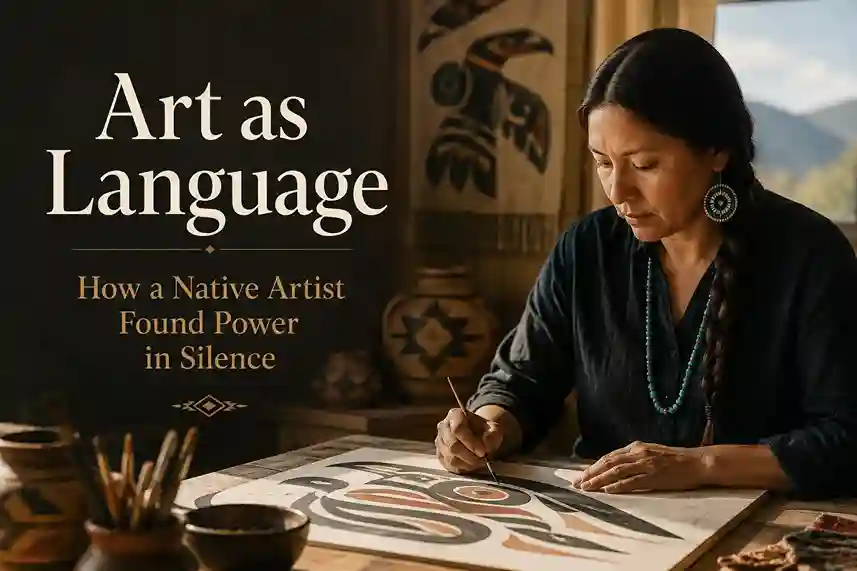
Rose B. Simpson grew up in Santa Clara Pueblo in New Mexico surrounded by generations of artists and thinkers. Her mother Roxanne Swentzell and her grandmother both forged paths that united making and meaning. For Rose there was no difference between art and life. Everything was a creative process. Everything had intention and meaning. What her family did and how they moved through the world had an invested interest in creating a reality that was aesthetic. This way of living shaped everything she would become.
Growing Up in a Home Where Art Was Life
Rose’s mother is an incredible sculptor. She took the ability to work in ceramics that came from generations before them and used it to communicate in a way she needed to. It became their livelihood. Her mother supported the family with her sculpture. But the art world was something very strange because her mother was also making the pottery they ate out of. She used her ability to craft earth to build their home and grow their food. That utility and relationship with clay was innate in all walks of their life.
Rose describes her childhood home as experimental. Her mother once turned off the electricity to see how the family could adapt. It was really frustrating when Rose had to catch the bus at 6:30 in the morning without electricity. But now she is so grateful. Her mother is always searching for ways to root and figure out how to apply the innate values of relationship to Earth and being in all walks of life.
Part of that was growing all their own food and figuring out how they could live sustainably. They have the privilege of living in their ancestral home. They have seed and relationship to spirituality that can foster farming. Those seeds have been adapted to that environment for a very long time. They have tradition passed down for generations to be able to support themselves in the high desert of northern New Mexico.
Turning off the electricity was one step towards remembering what it is like to not be dependent on a system. Her mother also homeschooled them for a long time and they grew their own food. Because of all this, Rose can actually hear electricity now. She is really sensitive to it. We adapt to all the things we add to our lives. When we take them away, we start realizing how much we are affected by them.
What Self-Reliance Taught Her About Choice
Understanding true sustainability means that we always have a choice. Her mother did not put them into the school system. She intentionally homeschooled Rose and her brother from early on. They chose to go to school later. And now they keep going to school. This was a way of building a capacity in them to choose. There is always a choice. We are not victims to the world we live in. If we are taught how to be sustainable and how to innovate and figure out how to survive in any situation, then we are in our agency when we navigate the world around us.
Rose sustains this by remembering that she does not need the things she thinks she needs. We are told over and over that we need certain things. Every single day she realizes it is a choice she is making. Then she is in her power in relationship to it. As long as she does not need something, it does not rule her. It does not own her. She maintains her relationship with the natural world and her food sources. She actively engages in the relationships she is making. That includes the art world, car culture, education, and all the decisions in her life.
The Deep Connection to Car Culture
Rose grew up in Espanola New Mexico. This town is sandwiched between two tribal nations. The youth culture there is very mixed between indigenous communities and local Hispanic communities. Everyone grew up together. Her youth culture was very much about lowriders and what would be the cholo culture in the Hispanic community there.
As a little kid, her mother had a 1952 Willys truck that she built their house with. There was no room for the kids in the front seat. So they used to sit in the bed of the truck as her mother drove through town. Rose would watch all the cars pile up behind them because they went max 40 miles per hour. She would look at all the nice cars and think that when she grew up, she was going to have a nice car. That was the goal.
And yes, that happened. She now has two custom cars that she built for herself. She built them in order to have an aesthetic experience. Relational aesthetics to her means the intentionality of all that we do and applied aesthetics to our lived environment. Growing up in Espanola, the cruise line on Sunday is everybody getting in their nice car, putting on some good tunes, leaning back, being present, enjoying the community, having a sense of self-worth, and enjoying the sunset. That feeling is presence. That feeling is when aesthetic gets reapplied to our life. When we make those aesthetic decisions, we are in a state of agency and empowerment.
Rose built herself that moment to create that aesthetic experience. She felt it was reminiscent of what she knew of applied Indigenous aesthetics. It is not in a white cube in some building somewhere where you do not necessarily have access to. It is for everyone. Everyone has access to that experience.
Moving Between Different Art Forms
Rose’s work moves between ceramics, metal, automotive restoration, and performance. She never imagined those boundaries dissolving. It happened organically over time. She always wonders if she stopped being an artist in the way the world defines art, she would still be doing stuff. She would still be going from one place to the next and making things constantly.
She is always interested in imagining the next best thing. She looks at a car and does not see the car. She sees what it could be. She looks at a garden and does not see the garden. She sees what it could be. And then she begins. She will always be doing that no matter what. She is always going to be searching for how to better the world around her and how to listen to it. She asks how she can be of service and then does the work.
The satisfaction of stepping back and seeing how something transformed is that applied aesthetic to the world around her in all things. That is also internal. It is an internal investigation of psychological and spiritual spaces.
Cars and Sculptures as Vessels
Rose has called cars vessels. Many of her sculptures are vessels for transformation. These vessels hold consciousness. She is a vessel and she is aware and she is moving and she is making decisions intentionally in this world. She makes ceramic vessels that are hollow inside. They are watching. They are doing work. They are independent. They make their own decisions. They move through the world with a job to do.
Cars are the same. The houses we live in and the spaces we inhabit are all watching, all listening, and all making decisions if we are aware. The first thing we can do is begin to ask. And then wait for an answer. We have consistently built a muscle inside ourselves of prioritizing human interaction. We have stopped understanding and believing that we can be in communication with that which is beyond human.
Rose makes anthropomorphized vessels in ceramics so that it is a bridge. Humans really like to talk to other humans. If we can see an anthropomorphized face and start feeling and listening, then we can begin building that muscle of communication with that which we have deemed inanimate.
The Significance of Open Eyes and Closed Mouths
In Rose’s figurative work, she does not always include things she does not think are necessarily important like arms or hair. But they do have the senses. They have ears, nose, mouth, and eyes. She wants them to have what they need to soak in the world around them and to create a relationship with that. When people see that, they will also build a relationship understanding that these pieces are sensing them.
When she cuts the eyes into the clay for the first time, she always says hello and welcome. This ritual is important to her. It acknowledges the life she is bringing into the work.
Being a Vessel for Creative Communication
Rose totally agrees that artists are vessels for creative communication. She believes creativity comes through us. For instance, when she is doing a public art piece, she has to go to the place. She sits there and asks what needs to be here, what needs to be told, and what story needs to be manifested here to make change. She asks how she can be of service. Then she waits and listens. And it comes. It comes real fast.
It is like truth. There is only truth. When you are in alignment with it, it is like you just tuned into it and boom, you found it. Then it is time to get started. When she enters the studio, she gets into that place and asks what needs to be done, what needs to be said, and how she can be of service.
When she first met her 1985 Chevy El Camino named Maria, the first day she painted her, she made her satin black with a gloss clear. It was made to look like traditional pottery. She brought her home and sat on the porch looking at her. She realized she did not do this. It was not her. Maria used her to make her into what she was always meant to be. She just listened. It is incredible to see and give the power back and say thank you for choosing me to be a part of this process of your becoming.
Finding Your Aesthetic Yum
Rose loves the subject of aesthetic. She likes teaching aesthetics to students. Have you ever heard the term do not yuck my yum? To her, aesthetic is when we let go of our thoughts and find our yum. Sometimes what we thought was our yum is not. We have to sit with it long enough. How do you refine and refine your yum until it is just right? You close your eyes and feel it click. That is finding it. It is tuning to it.
Having that self-reliance means knowing you can trust your sense and judgment. It is a muscle and we have to build it. Rose has talked about animacy and the soul of things. She blurs the line between making and being. A lot of that is about listening.
The Silence She Hopes Her Work Leaves Behind
The silence Rose hopes her work leaves behind is the one that is full of information. There is so much to learn when we shut up. Her pieces, unless they have 410 horsepower and are going really fast, are very quiet. In that silence, there is connection. That connection is what matters most.
Conclusion
Rose B. Simpson teaches us that art is not separate from life. It is a way of surviving and thriving. Her journey from a childhood without electricity to becoming a renowned artist shows us the power of self-reliance and listening. She reminds us that we always have a choice. We are not victims to the world around us. We can tune into what is real and true. We can build our own aesthetic experiences. We can find connection in silence. Her work stands as a powerful example of how making things with intention and meaning can transform not just objects but entire lives and communities.