How a Simple Tool Lets Regular People Correct Misinformation Online
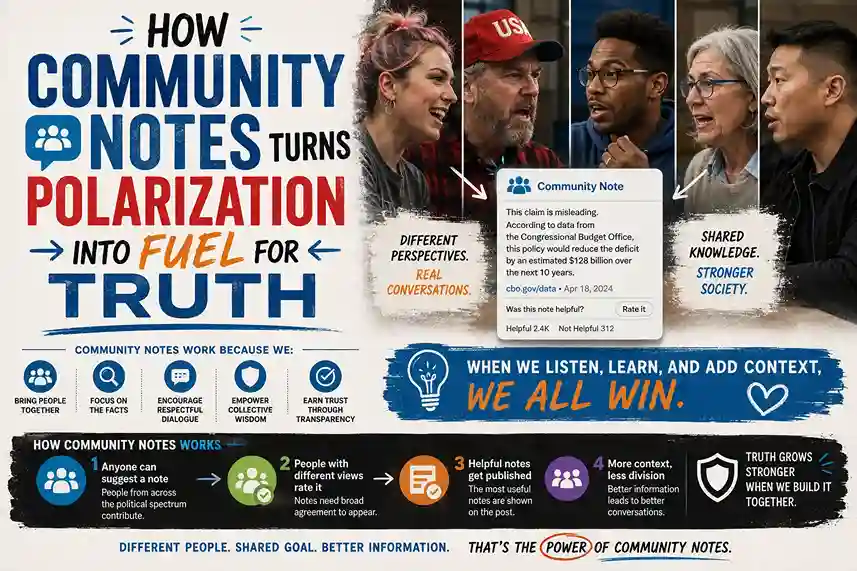
Community Notes was built to create a better informed world. As it expands to more parts of the internet, more people gain access to accurate information. The system started on a social media platform and has grown into something remarkable. Regular users write notes that provide context to posts. These notes are not shown unless they are rated helpful by people from different perspectives. What makes this system special is that it does not rely on tech companies deciding what is true. It relies on the wisdom of crowds.
How Community Notes Actually Works
A real example shows how the system functions. A post about Iran claimed a naval ship had been damaged with casualties. But the image was actually AI-generated. A Community Note appeared on the post saying “readers added context they thought people might want to know.” The note gave specific details about what was wrong in the image. This level of detail is a big reason why people on both sides of the political spectrum trust Community Notes more than generic misinformation warnings.
These notes are written by regular users called Community Notes contributors. Before they appear on the platform and attach to a post, they are rated helpful by people from different perspectives. They are not shown unless that happens. Many of the best notes are not just fact-checks. They can add context to posts that are correct but otherwise misleading.
All Posts Are Eligible for Notes
A really important principle is that all posts are eligible for notes. This includes posts from heads of state and posts from the company itself. Even the CEO’s posts get noted regularly. The system identifies AI-generated imagery, which has been common recently. It detects deepfake audio of world leaders. It covers lighter subjects like entertainment and fashion too.
There have been multiple notes on recent government administrations. In at least one case, a government office actually took down the posts and issued an updated statement. A random person on the internet wrote that note, not a famous person. They saw an official post said something wrong, typed in the note, and suddenly leaders changed their public statement. That is a superpower for regular people.
The Origin Story of Community Notes
The origin goes back to the 2016 election. The creator was just a social media user then, following the election. There were three televised debates that year, but every day there was a debate on the platform. That was where the world was following. There was a lot of good information, but it was also hard to tell what was true.
Fast forward three years. The creator was working at the platform and the industry had tried a lot of things. Other platforms had built huge fact-checking programs. There were internal teams reviewing posts to decide if they were misleading. There were issues with speed. Typical fact checks often came back in two to four days, which is infinity in internet time. Scale was an issue. People could review about ten posts or topics a day. Trust was the fundamental issue. Many people did not want tech companies deciding what was accurate.
So the idea was to prototype something new, and one of those ideas became Community Notes.
Why People Trust Random Strangers
People do trust Community Notes on both sides of the political spectrum. There are a couple of big reasons why. One is that the process is totally open, transparent, and verifiable. Anyone can download the real algorithm code that runs in production. Anyone can download the real data of Community Notes and ratings, run the code on the data, and verify that there is no funny business. There is no override button. It is really by the people.
The notes are just really good. They speak for themselves and tend to be very accurate. The main reason is the principle behind the algorithm. It does not ingest any external authority. It decides what notes to show by looking at agreement from people who have disagreed in the past. Sometimes this is called surprising agreement or bridging.
How the Algorithm Uses Polarization
Every dot in the visualization is a Community Note. The y-axis shows how helpful the algorithm thinks the note is. The x-axis shows the point of view of the note. Polarizing notes are only found helpful by people on one side or the other. Those do not show on the platform. The only notes that show to everyone are the ones found helpful by people who typically disagree.
There is also a community moderation element. If someone writes too many low-quality notes, they can lose their privilege for writing Community Notes. The algorithm takes advantage of partisanship and polarization. For any Community Note on a polarizing topic, there is always someone predisposed to disagree with that note. Before they rate it helpful, they fact-check it from every angle. They check the sources in detail. As a result, the notes that are found helpful tend to be very accurate, use primary sources, and be neutral in their language.
No Veto Power for Anyone
When a head of state gets noted and calls the CEO asking to take it down, the answer is simple. There is no override button. If someone is not happy with a note, they need to take it up with the people. This was a crazy idea when they started. They went into a room full of trusted safety people and said the notes that show will be the ones the people decide, and they cannot be taken down. There is no veto.
The point is that if it is the tech company’s opinion, why would anyone trust it? It needs to be the people’s opinion. They stuck to that principle. Everyone got behind it. There is no way of changing the status of a note.
What Happens After a Post Gets Noted
When a post gets noted, the views totally flatten out and it gets almost no more views. The crazy thing is it is actually not getting down-ranked by the algorithm. This happens because of organic user behavior. People realize the post is incorrect because the note is on it, so they like it less and repost it less.
Because the data is totally open, researchers from universities around the world have found the same thing. Reposts drop by about 50 percent after a note is applied. This is really big in the scale of social media. Even one or five percent would be pretty big in typical A/B tests. People are not just entrenched in their beliefs. When a note is applied to a post, they agree with the core claims in the post less.
There is a mixed blessing though. Post authors are more likely to delete their posts after they get noted. So the best notes actually get seen very infrequently. Some people would rather see a post and a note than neither at all, because that is probably not the only time they will see that particular wrong claim. Seeing notes increases the skepticism people have when reading things.
How People Respond to Corrections
People often assume the world is very polarized, and it certainly feels that way. But when people see a post and see a correction, they make a choice. They see that things are wrong and just do not share it. This happens across the political spectrum. When the product was being designed, interviews with hundreds of people on the left and right showed that most people just want to know what is going on in the world. They know they are consuming incorrect stuff. They just want to sift through it. When given information, they try to make a good decision.
Defending Against Manipulation
Manipulation is a real thing. People are always trying to game social media algorithms, and Community Notes is no exception. The surprising agreement mechanism provides a defense against naive attacks. Many people with the same view piling on to get an incorrect note showing will not work.
For more sophisticated attacks, there are many defenses. These include requiring a verified phone number from a trusted carrier to increase the probability of dealing with real humans. The system looks for raters who have rated things very similarly in the past and might treat them as the same person to limit the influence of really similar behavior. Random samples of raters are checked. If they are rating things very differently than self-selected, possibly malicious raters, that is a very important signal.
There is also rater reputation to deal with low-quality people. Community Notes are incorrect sometimes, but because it is really rare, there is a self-correcting property. Incorrect notes attract a lot of attention and draw many raters to rate them not helpful, and then they stop showing. This self-correcting property is super important in breaking news situations. Something that was true a few hours ago may not be anymore, so notes are not set in stone.
The Speed Problem and AI Solutions
Previous state-of-the-art fact-checking would often take days. Community Notes is usually more in the order of hours. Notes can appear as often as about 20 minutes on a brand-new post. They can appear instantly if there is already another note out there matching on a URL or image or video. If someone engages with a post before a Community Note appears, they get a push notification later with the correction.
Last year, an open API for AI contributors was opened. Regular people can write their own AI-note writers and submit notes to the system. It is working really well. The notes are fast and quite good, but because it is AI, they are wrong some of the time. There is still a human layer where humans rate the notes the same way as any other human-authored note. The goal is for AI and humans to collaborate more effectively to co-write better notes faster.
Humans and AI Working Together
The idea is to have humans and AI co-write and co-create notes together. This allows for much faster speed and larger scale. When there is demand for a note, AI takes a first shot at it. Humans can also write. In a real example, the AI thought a video was from 2017, but it turned out it was not. Humans went in and corrected it, saying it was from 2022. People rated it and made suggested improvements on style or tone. They could say a source was biased or a primary source should be used for more trustworthiness. The AI takes that, regenerates a note, and usually gets it right.
This creates a better note on the post people care about. All those corrections and suggestions become training data fed back into the AI. This makes it less likely to make that mistake again. It makes it better at researching and more neutral and less biased. All the human suggestions make better notes and better AI.
Reinforcing Learning from Community Feedback
This is called reinforcement learning from community feedback. It is different from reinforcement learning from human feedback, which might use a smaller biased set of non-representative people. In the case of Community Notes, it directly trains the model to write notes that would be maximally likely to be found helpful by a simulated set of raters who typically disagreed in the past.
Can Community Notes Keep Up with Peak Slop
With the surge in synthetic media, especially recently with conflicts around the world, Community Notes is on the frontier. These are new problems, so no one knows what will work. But there are reasons to be optimistic. In the last four months alone, the number of notes showing on the platform has doubled. There is clearly headroom to grow.
On the incentive side, one reason people post misleading things is they can make money through revenue-sharing programs. Changes have been put in place where if a post is noted, the author cannot make money off it. If someone posts AI-generated footage of a conflict and does not clearly call it out, they are suspended from the revenue-sharing program for three months. If they do it again, they are suspended forever. These changes shape the underlying motivations people have.
The Future of Common Ground
What if instead of just corrections, the system could find ideas or opinions liked by people from different points of view? A pilot program is running where posts get a call out saying “liked by people from different perspectives.” People were very happy to see a company not allow special treatment for government officials. There is agreement across a lot of topics, even controversial ones like immigration, the economy, taxes, and international conflicts.
There really is a lot of agreement out there. Not on everything, but quite a bit. If this common ground can be identified and shown to people, it might incentivize more of it. People might try to speak more in a way where they can find agreement and get more momentum behind those ideas.
A Vision for Beyond Social Media
Imagine for one session of government, everyone just focused on delivering where there was agreement, whether it is immigration, taxes, or whatever. People would be happy. There is a lot of agreement on these topics. If all that was pursued were the areas of agreement, people would be pretty happy with the direction the world was going.
The hope is that with programs like this, common ground can be identified at internet scale. This will make it much easier to create a future that humanity likes. The data becomes soil, and understanding between different communities grows together. AI agents grow with communities, loyal to communities and not trying to extract anything, but just to regenerate deep understanding.
Conclusion
Community Notes represents a fundamental shift in how we handle misinformation online. Instead of tech companies deciding what is true, regular people work together across political divides to provide context and corrections. The system turns polarization into fuel for accuracy, as people on both sides fact-check each other’s notes. The open-source, transparent nature of the tool builds trust. With AI assistance and the focus on finding common ground, there is genuine hope for a pro-social media future. The technology is already here, and it is showing that people are not as divided as we might think. When given the right tools and incentives, humans naturally want to be helpful and accurate. This is how we can keep our humanity on the internet.