How Marine Protected Areas Are Restoring Life to Our Dying Oceans
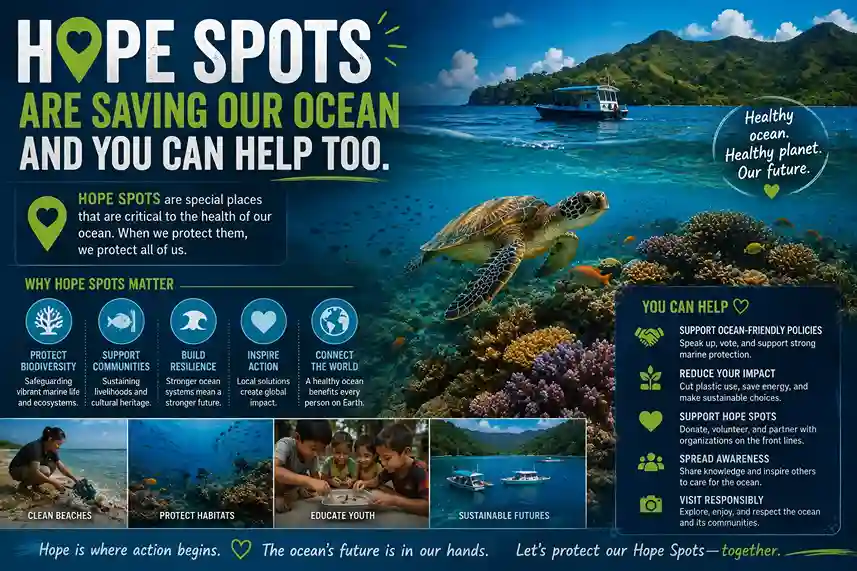
In 2009, a renowned oceanographer stood on a stage and made a wish. She wished to use films, expeditions, the web, new submarines, and a campaign to ignite public support for a global network of marine protected areas. She called them Hope Spots. These areas needed to be large enough to save and restore the ocean, which she described as the blue heart of the planet.
Why the Ocean Needs Protection
The ocean is our life support system. It needs to be treated with respect. The oceanographer’s wish came from a lifetime of diving and exploring places that most people will never get to see. She used more than 30 different kinds of submarines and spent days and weeks underwater at a time. She witnessed the dramatic changes taking place in the ocean.
She also witnessed how humans are trashing the ocean. This includes not just what we are putting into the ocean, but what we are taking out. Industrial fishing is stripping the ocean of wild creatures that maintain Earth as a habitable planet. With billions of dollars in subsidies, we have dewilded the ocean. Wild animals cannot escape the mechanized killing of industrial fishing fleets that move like cities across the high seas.
The Devastating Decline of Marine Life
We almost succeeded in exterminating the great whales. Now we know we need whales, squid, menhaden, tuna, shrimp, and sharks. Ocean wildlife needs to stay alive. The carbon cycle shows how the living planet works. Elements of the universe move from one creature to another, keeping Earth’s chemistry within safe operating space.
Fifty years ago, people were told to be afraid of sharks. Now the oceanographer is afraid because she does not see sharks when she goes diving. More than half of them have been eliminated since she began diving. Coral reefs have also changed dramatically. The images of coral reefs from decades ago are not what we see today.
The Birth of Hope Spots
In 2009, the oceanographer wished for expeditions, films, the web, and new submarines that inspire action. In that same week, the first 10 Hope Spots were launched on a global mapping platform. In 2010, an expedition to the Galapagos Islands brought together about 100 big thinkers to figure out what could be done to change the trajectory of decline.
On the spot, a commitment was made to protect the high seas starting in the Sargasso Sea. The Sargasso Sea Hope Spot is the open ocean home for turtles, whales, sharks, and thousands of other sea creatures. Other commitments included creating films and launching organizations to support ocean protection. Funds were created and secured to help protect the Galapagos Islands.
Expanding the Mission
Five years later, with climate as a top priority, another expedition sailed to the South Pacific. Champions were enlisted to help protect the top of the world, the high seas in the Arctic. They worked to stop the trade in wildlife like polar bears for rugs and trophies. Others were enlisted to bring about full protection for krill and other wildlife in the waters around the Antarctic continent.
When asked about the best place to go diving, the oceanographer says, “Almost anywhere 50 years ago.” So much has changed. There are some places where the ocean is still intact. These places have top priority for protection because they cannot be put back once they are gone. While we can help restore some of the damage, nothing compares to a place that is still intact.
Reasons for Hope
There is hope because around the world, people are doing what they can to restore coral reefs. Mission Blue champions in 29 Hope Spots are growing and planting corals to help restore the damage. In the Nusa Penida Hope Spot, you can actually see the progression from a damaged reef to restoration and recovery.
Champions are helping to inspire protection for wild rivers and pathways in the sea for manatees, turtles, fish, and whales. Today, there are 169 Hope Spots in 116 countries. These are not just dots on a map. These are people.
What Hope Spots Are Achieving
People are gathering data, sharing stories, and enlisting kids to care. They are diving in with partners and connecting with others. Mangroves are being restored in 15 Hope Spots. Seagrasses in 12. Turtles are being monitored in 26 places. Sharks and rays in 30 places. All of these places are creating awareness and enhanced protection.
Success Stories from Around the World
Chile’s coast and offshore waters were among the first Hope Spots. They are now part of Chile’s commitment to protect more than half of their ocean area. When the oceanographer first went there, she found just one Juan Fernández fur seal. It was thought they were gone. That was a cause for hope. Today, with protection, there are more than 100,000 of these creatures.
In the shadow of New York City, the Shinnecock Bay Hope Spot is a place where people and nature thrived for thousands of years. But 20th-century markets for seafood upended the system. The bay became known for brown tides and the loss of seagrasses, oysters, and clams that once filtered the water and fed people locally.
A scientist at Stony Brook University set out with her colleagues to do something about it. They figured it would take 53 million clams to restore health and filter the water. They calculated it would take $53 million at a dollar per clam. They did not have $53 million, but they bought as many mom and dad clams as they could and planted them. They let the clams do the rest. Seagrasses began to grow again once the clams were back. The water became clearer. Creatures that need the seagrasses began to return.
Science-Based Tourism and Conservation
In French Polynesia, at the Tetiaroa Hope Spot, pioneers are leading science-based tourism with a conservation twist. They have fiercely protected sea turtle nests. They have taken action to restore a place that was losing the wildlife the ocean needs. Just a few years ago, there were only a very few turtles. Now there are hundreds. Protection works.
They are engaging tourists, scientists, kids, and business leaders in a business plan that couples tourism revenue with exploration, research, and conservation. It is a nature-positive model that generates income and jobs in a healthy ocean.
New Technology and Ancient Wisdom
A new class of submersibles is being built that will take scientists, visitors, and curious kids into French Polynesia’s twilight zone. They will explore a vital global system of animals that migrate up and down in the water column every day and every night.
Mission Blue is partnering with Polynesian voyagers who travel across the Pacific in traditional voyaging canoes, following ancient pathways depicted on traditional maps like an octopus. The head of the octopus is in French Polynesia, but the arms extend to islands across the Pacific to Hope Spots established in recent years. A three-year expedition is currently underway to connect people across the Pacific with ancient values of ocean care and respect.
With the submersibles for the first time, they can go see who lives under the canoe. This is where it is cold, dark, and high pressure, but it is where most of life on Earth actually exists. This is the merger of new technology and ancient wisdom.
The Need to Scale Up
The oceanographer’s wish was inspired by the keen desire to build a safety net of Hope Spots large enough to really understand and protect the ocean that protects all of us. At the time, 99 percent of the ocean was open for exploitation. Today, 97 percent is still open for exploitation. It is time to seriously scale up.
Hope Spots are helping. Technology is visualizing Hope Spots with global data on temperature, chemistry, fishing pressure, wildlife migration routes, and land-based information. This helps us better understand the problems in the context of the whole world.
What We Can All Do
Planting trees, planting corals, and planting clams helps. We can stop trashing the ocean. We can stop industrial fishing. We must never allow the mining of the deep seas to sweep away the security the living deep ocean provides to all of us.
Armed with greater knowledge than has ever existed before, we are the luckiest people ever to have arrived on Earth. We can choose the future we want. Dinosaurs could not. We have a choice. We can find an enduring place for ourselves within the natural living systems that make possible our existence. Systems that sustain us.
Conclusion
Hope Spots are helping to restore the ocean and protect marine life. But the work is far from complete. With 97 percent of the ocean still open for exploitation, there is an urgent need to scale up protection efforts. Everyone can contribute to this cause by supporting marine protected areas, reducing consumption of ocean wildlife, and spreading awareness about the importance of ocean conservation. Hope is contagious. Hope is an idea worth spreading. The ocean has given us so much. It is time to give something back.