Why Every Child Deserves the Right to Play Their Own Way
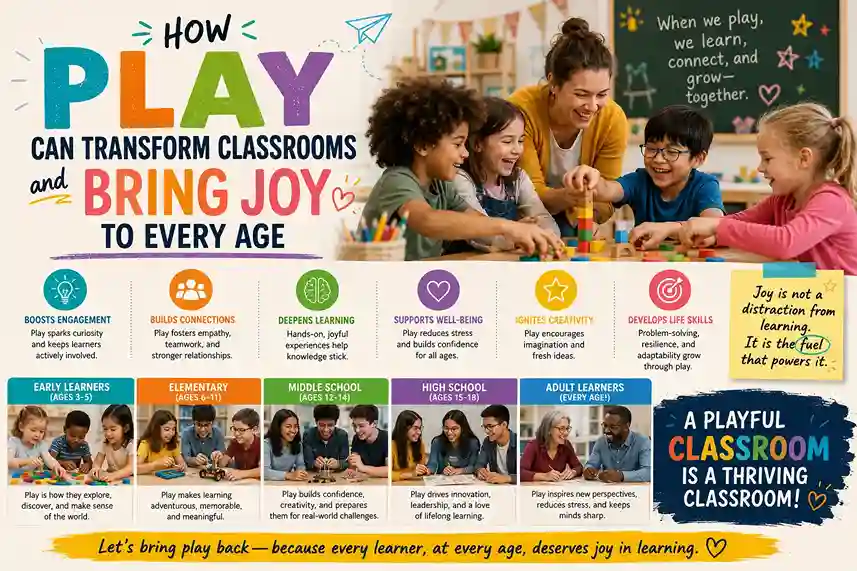
Play is not just for children. It is something that adults need too. At a recent event called Play at TED, many speakers shared their ideas about play. They talked about how play helps us learn, grow, and connect with others. From a fifth grader to an origami innovator, everyone had something important to say about play. This article brings together the key ideas from that event.
The Importance of Play in Learning
One of the main messages from the event was that play is essential for learning. When children play, they explore without worrying about being right. They imagine new games and invent rules. This natural curiosity helps them develop skills that worksheets or lectures cannot teach.
A student from the event shared how play helps her learn. She said that when learning feels like a game, you stop fearing mistakes and start improving faster. Instead of asking how to work harder, we should ask how to make learning more playful.
Another speaker talked about how failure feels different in games. When you lose a video game, it simply gives you another chance. It does not judge you. It just restarts. This teaches us that failure is not the end. It is part of the process.
Play as a Language
One expert explained that play is a language we all speak. She coined the term creative health to describe how play and creativity support human well-being. She shared that as a child, she felt like play was something she had to earn. She would gather her toys and wait for something perfect enough to make. That moment barely ever came.
As an adult, she studied the science of creativity and discovered something surprising. Creativity is not just a talent. It is a core part of our well-being. One of the best strategies to strengthen creative health is play. When we play, especially as adults, we unlock a unique type of flourishing. We have deeper fulfillment, stronger resilience, and more original ideas.
But the type of play she talks about is probably not what we imagine. It is not just being silly or childlike. From a scientific perspective, play is what happens anytime we choose to do something without knowing exactly where it will end up. There are no instructions to follow or outcomes to achieve. Just two elements: intrinsic motivation and the freedom not to know the answer in advance.
The Play Deprivation Crisis
The expert warned about a play deprivation crisis. We have systematically removed everything that makes play what it is, the spontaneity, the freedom, the wonder, from all parts of adult life. We replaced it with efficiency and achievement. In doing so, we are losing the very survival skills we need most right now. Things like our capacity to adapt, imagine, and even feel alive.
Upwards of 70 percent of adults around the world today have stopped playing. Play deprivation is tricky because at first we barely notice it happening. We just feel endlessly busy. But over time without play, stress can compound and burnout can become chronic. Then we walk around as playless adults, which ultimately creates a playless society. One where our institutions can grow rigid, lonely, and polarized.
How to Bring Play Back into Life
The good news is that we can change this. Play is not something we age out of. It is a lifelong trait. No matter how invisible it might feel, we can always restore it.
The expert shared three places to start injecting play back into our lives: during work, before sleep, and in public.
At work, most of us get stuck in linear task-oriented thinking, churning through to-dos and back-to-back meetings. But neuroscientists have found that spontaneous imaginative thinking lives in a different part of our brain called the default mode network. That gets activated when we do things we do not normally consider productive. Playful people mind wander and daydream. We often call that laziness, but underneath the surface, our creative brain is actually hard at work connecting disparate ideas.
Before sleep, most of us feel exhausted. We reach for ease and want our lives to be frictionless. But our play and our lives need friction. There is a type of positive stress that comes about when we do things that require effort. That is why physically playing or making things with our bodies actually expands our energy and even our perception of time.
In public, the last and most insidious sign of play deprivation is cultural. It is when we do not just deprioritize play ourselves, but we actively punish it in the world. Silencing music in our parks or calling leisure time lazy. Research shows that just being in proximity to people playing can motivate us to do it too. So next time you see a musician in the park, take out your headphones and listen for a moment. Maybe be the first to laugh or clap or join in.
Play as a Craft
A game designer shared his perspective on play. He explained that rules are the essence of what a game is. Rules tell you what to do each turn and how to win. But the amazing thing about games is that if you decide to enter into those rules, then what happens is play. Play is the opposite of rules. If rules are logical, rigid, fixed, and unchanging, play is spontaneous, creative, and unexpected.
He demonstrated this with a game where two volunteers had to alternate saying words. At first, it was not very fun. But as he added more rules and constraints, something happened. The players became more focused and intense. The audience started leaning forward and making suggestions. They started to see amazing play with the rules.
This is what game designers do. They work with constraints. These constraints focus and guide the play of players. It may seem when you are playing a video game that it lets you go anywhere and do anything. But from a designer’s point of view, constraints guide and focus the creative activity.
He encouraged everyone to apply this methodology to their own work. Look at and understand the system. How does it work? How is it structured? Then find the leverage points for play. How can you start poking around and playing with the system in unexpected ways? Do not be afraid of constraints. Use them to guide and focus the behavior of your audiences.
Play as an Adventure
The event also featured an origami innovator who showed how playing with paper can lead to scientific discoveries. He started folding origami over seven years ago, making ornaments for his family’s Christmas tree and getting in trouble in class for turning his worksheets into ninja stars and paper claws.
Over time, he began folding more complex origami and even designing his own models. He found that origami has the power to help others. During the pandemic, he wrote cards and mailed origami birds to seniors at a local nursing home. More recently, he folded 200 origami pigeons and 100 sparrows, selling them to raise over $4,000 for a local soup kitchen and a nonprofit that rehabilitates injured birds.
His interest in the intersection of origami and science led him to study a fold called the mirror ori. It was invented in the 1970s by a Japanese astrophysicist. It is a repeating pattern of parallelograms that can fold down to an extremely compact size in one smooth motion. This makes it an efficient deployable structure that has even been used to fold a solar array sent into space.
For his eighth-grade science fair project, he designed 18 different folding patterns and tested them across three different paper weights. He found that the strongest pattern held almost 200 pounds, and another lighter version held more than 10,000 times its own weight. This work earned him the top prize at a national STEM competition.
Play as Radical Inclusion
A researcher from Finland shared her work on play worlds. Play worlds are adult-child joint play often structured around a piece of literature or a work of art. Adults and children create the world of a chosen story in the classroom. Then the class plays, interacts, and undertakes adventures together.
She explained that in most classroom settings, disruptive behavior would be considered problematic and something to prevent. But inside a play world, it makes sense and can even help solve problems. She shared an example of a child named Viola who was often inattentive and disruptive. When the class was discussing how to save magical creatures from an evil witch, Viola suggested blowing up the whole school. Instead of excluding her, the children negotiated and asked if she could blow up some props instead. Viola agreed and became an active participant.
Another example involved a puppet named Reuben that a teacher brought into the classroom. Children who were struggling with disengagement and difficult behavior developed a special bond with Reuben. It often sat in their laps during difficult activities, making them calmer and more attentive. On a school field trip, a child who often could not join because of his behavior was put in charge of Reuben, and it made it possible for him to go.
The researcher emphasized that the value of adult-child joint play needs to be better recognized in early learning. Teachers who play need to be supported and trusted by their school systems. If this happens, play worlds can help us imagine and build better futures with our children, futures where everyone has an important role to play.
A Young Person’s Perspective
A fifth-grade student shared her perspective on play. She noticed a contrast between how her father acted at the water park, relaxed and playful, and how he seemed on work calls, less happy and more tired. This made her realize that play is not just a childish activity. It is something adults need to do to connect more deeply to their families and live life more fully.
She explained that adults often have play guilt because their inner voice tells them that play is not productive and they should be doing something more beneficial. As responsibilities grow, play is often viewed as immature, unnecessary, or a distraction. Over time, that belief becomes automatic. Play starts to feel like a waste, even though it is actually one of the most effective ways humans learn, connect, and regulate stress.
She suggested that adults do not need to add more things to their to-do list to benefit from play. They just need to bring a play mindset of curiosity and exploration into responsibilities they already have. Instead of just managing schedules and routines, parents could race to pick up the most toys or clothes. While washing the car, they could start a water fight. After work, they could have a 30-second dance break.
She encouraged families to take one night a week to play, relax, and have fun together. She shared how she goes on walks with her dad and little sister, talking, laughing, and breathing instead of rushing through the day. On Friday nights, she and her mom make pizza together. It is messy and creative and reminds her of something her mom loved as a kid.
Children and AI
A researcher from MIT shared his work on how children interact with artificial intelligence. He explained that smart toys mimic intelligence and friendliness so well that children learn to trust them, sometimes more than they trust themselves. There is a real danger of children becoming overly reliant on or inappropriately attached to their smart toys.
He shared a study where a girl who loved sloths asked Alexa what sloths eat. Alexa replied it did not know how to help with that. The girl looked disappointed for a second and then perked right back up, picked up a second Alexa, and said she would see if this one knew.
The limitations of AI can be frustrating and confusing for children. Research shows that it can make them vulnerable to even more serious risks like manipulation or accidental exposure to inappropriate content. Even devices marketed as educational or screen-free are still consumer products designed to be endlessly engaging or addictive.
But the good news is that we can mitigate these risks by leaning into something children already do. Kids are natural reverse engineers. They play with AI devices, trying to break them and asking absurd questions. These questions are an example of children probing the machine about its very nature.
The researcher built a social robot called Popot, made completely out of Lego bricks. It makes complex ideas of modern AI easy to understand through hands-on, child-driven play. He taught children about machine learning by having them play rock paper scissors against the robot. The robot would pick up on their patterns and try to predict their moves.
One boy got very frustrated, so the researcher planted a mischievous idea. He suggested teaching the robot the wrong rules so the boy would win every time. This created an opportunity to talk about who teaches AI the rules. The boy realized that if he could teach the robot the wrong rules, how did he know Alexa was taught the right ones?
The big idea is that children need to understand that AI is not magic. It is a set of rules written by people. We need to raise a generation of children who know they are the ones who get to write and even rewrite the rules of AI.
Conclusion
The Play at TED event showed us that play is essential at every age. It helps us learn, connect, and grow. It can transform classrooms, strengthen families, and even lead to scientific discoveries. The key is to bring a play mindset into everything we do. We need to stop treating play as something optional or childish. It is a fundamental human need. Whether we are teachers, parents, or just adults trying to navigate life, we all benefit from more play. So let us take the lessons from this event and make play a bigger part of our daily lives. Let us be curious, explore, and most importantly, have fun. Because play is not something we grow out of. It is something we grow with. It helps us stay curious, connected, and human at every age.