How a Basketball Player Who Was Told to Stop Dunking Found Success Through Play
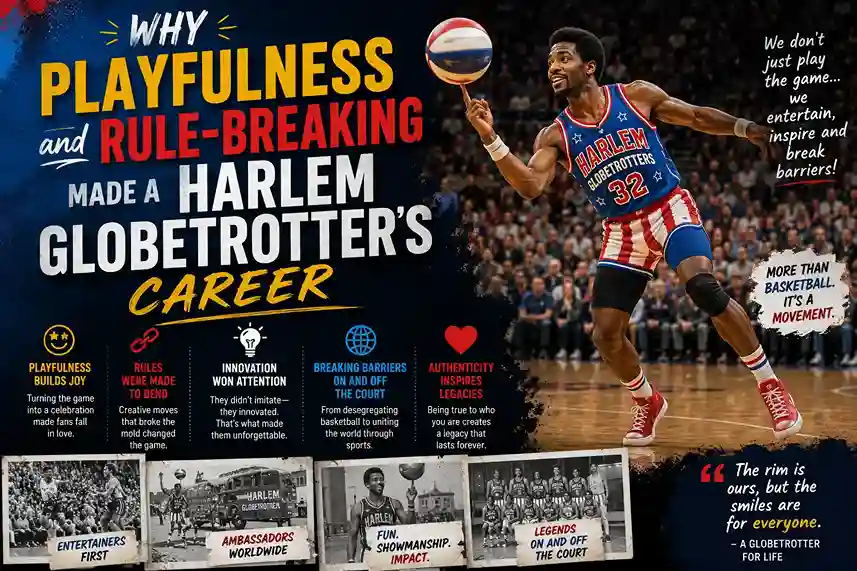
A video showed someone shooting a basketball off a 230-foot New York City building. That was a member of the Harlem Globetrotters, a legendary exhibition basketball team credited for integrating the NBA, popularizing new moves like the alley-oop, and creating so many others. These new moves advanced the game and gave joy to the people who came to watch them perform. That is precisely how the team has lasted for 100 years while also earning a spot in the Hall of Fame.
The Struggle with Traditional Coaching
Getting to this point in the career was not a straight line. The athlete always struggled with high-level sports coaching. There is a certain culture that has excessive cursing, yelling, and a hyper-seriousness that can really stunt growth. Although they were playing sports, ironically, they were coached not to be very playful. As a creative kid who loved art but was really shy, the constant confrontation with coaches was always robbing creativity.
There was a seriousness in respecting the quality of the game. Whether it was basketball, football, baseball, or cross country, all coaches emphasized honoring and respecting the essence of their sport. That meant taking every drill and every exercise seriously and not doing anything that would challenge the traditional way of doing things. This is exactly what led a high-school coach to tell the athlete to stop trying to dunk the basketball. Ironically, it was playfulness that got to this point in the career.
The Power of Play in Evolution
Play is the most important ingredient in every person and every industry’s evolution. As an athlete and an artist, there is witnessed how play can break rules to improve both of these worlds. Imagine if play, creativity, and a little bit of rule-breaking was in every industry.
There once was a time in basketball when dunking was frowned upon so much that the NCAA banned it for nine years. Once that ban was lifted, the popularity of the game skyrocketed. This context reminds of coaches yelling to stick to the fundamentals, all because of the audacity to try and dunk the ball one time. Thankfully, the athlete did not listen and got more and more comfortable with it.
Building a Global Reputation
Over time, the athlete was able to land a first dunk contest. With a lot of work, a global reputation for dunking the basketball was built. Experimentation with boundaries began, incorporating things not normally associated with dunking, like with a dog, catching a baseball, or catching the ball without looking from someone else who is not looking.
Every time approaching this with a playful mindset, the athlete was rewarded. Not only with advancing the game, but also with the opportunities dreamed of as a kid. Several video games featured these dunks. There were also opportunities to feature dunks in major magazines and sports programs, eventually receiving an honorable mention for a major award.
The Globetrotter Way
Unlike what coaches constantly bickered about, being a Globetrotter requires much of the opposite. So much of what people love about the game today was at one point deemed as not fundamental or non-traditional. There is a beauty in balancing seriousness with play.
When a Globetrotter makes a mistake, they can have it be overlooked because of how they playfully embrace its direction. They recognize that something went wrong, but they actually welcome the unfamiliarity that comes with that new position. For example, if a trick is tried and the ball is accidentally dropped, the momentum from that mistake can be used to grow it into something new. In order to get to that point, you have to be able to roll with it. Otherwise, you stop before you are ever able to discover something new. That is actually how new concepts are stumbled upon.
The Artist Side
The artist side came before being a basketball player. Basketball, amongst other sports, has allowed an ongoing relationship that impacts practice as an artist. Sports have given the tools to identify voids in and around life, while also giving a platform to fill them. As a really shy kid, art was the way of expressing oneself when sports did not give the opportunity.
Drawings of favorite anime characters were created. Paintings of animals were made. Over time, the focus shifted to people with real stories. Some experiences with basketball have allowed a new perspective. One day, some shoelaces were cut up and put on a canvas. It was not totally satisfying yet, but there was something significant there. Using this as a medium has allowed communication of identity through pieces.
The Medium of Sports Equipment
One of the signatures constantly through the work is using pieces of equipment that are a part of the personal journey as an athlete. Sometimes that is cut-up basketballs from a past Globetrotter game. Other times, that is tennis racquets from childhood. And sometimes, it is just shoelaces worn when doing something important. Play has given the flexibility and the vision to see these materials as something more than just what is used on the court or on the field.
All of these items have stories behind them. They have connections to the people that used them, whether it is the tennis ball that bounced several thousand times to bring people together, or the spinning basketball that brought smiles to so many people’s faces around the world, or shoelaces worn on a bad day but knowing that movement was still needed. Play is what brings all of these things together, figuratively and physically.
Conclusion
The world’s brightest thinkers and engineers of evolution all play too much. Playfulness is not a distraction from success. It is the path to it. The Harlem Globetrotter who was told to stop trying to dunk found that playfulness was the very thing that made his career. The creativity that was discouraged by coaches became the source of innovation and joy. Whether in sports, art, or any other field, play allows people to break rules, discover new possibilities, and evolve. The lesson is clear: do not let seriousness stop you from playing. Embrace the unfamiliar, learn from mistakes, and let playfulness guide you to places you never imagined.